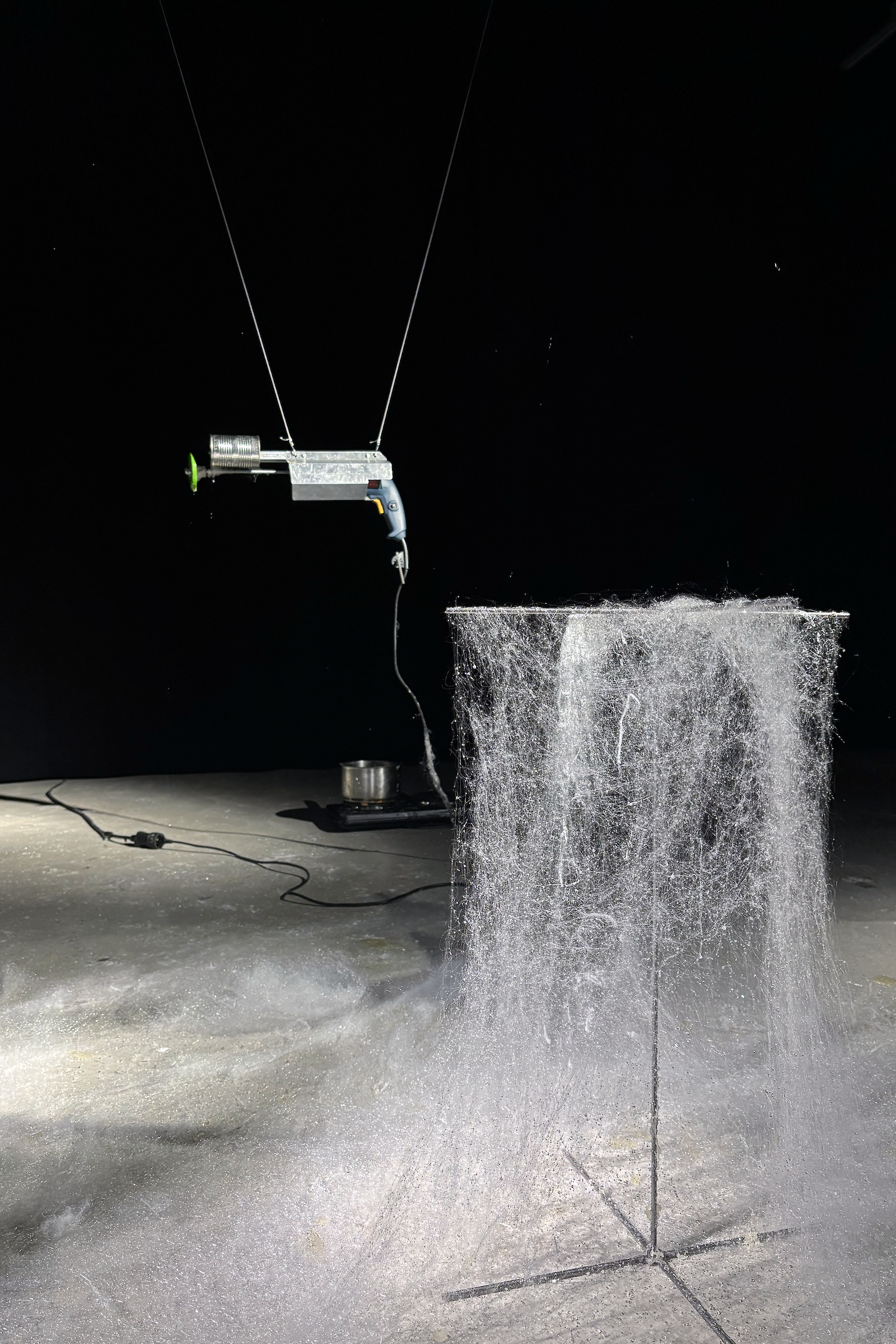
Prototyping Ecologies: Toxicity
HS 2025
The Protoyping Ecologies module is run between the Master Industrial Design and Master Interaction Design courses. It is led by Lukas Franciszkiewicz and Rasa Weber.
In remote waters of the Northern Pacific, on a small coral-reef atoll called Bikini (Marshallese: Pikinni), a giant bomb crater, so big that it is visible even from space, has been ripped into the coral reef ring. The American Navy‘s nuclear tests have left their mark on the remains of this ‘pristine‘ ecology. However, more than half a century later, scientists have found that coral reefs are thriving amidst an island ecosystem that has long been abandoned by humans and is heavily contaminated by toxic nuclear waste. It seems as though these corals have incorporated the nuclear waste into their organisms. Perhaps the world today is like this – toxic.
Toxic soils, toxic masculinity, toxic capitalism, toxic industries, toxic mines, toxic food, toxic politics, toxic rivers, toxic lakes, toxic reefs, toxic geologies, toxic ecologies, toxic bodies, toxic toxic – toxicity dominates our ecological reality. Not least among these were the toxic pesticides that contaminated plants, animals and humans, encouraging Rachel Carson to write her ground breaking book Silent Spring (1962), which laid the foundation for the worldwide ecological movement. However, our current situation does not permit fantasies of returning to a ‘pristine‘, Eden-like state. Rather, as the philosopher Alexis Shotwell unapologetically argues, we must acknowledge that «All of us on this earth are part of what Anna Tsing calls a disturbance regime—we’re all living in blasted landscapes.» (Shotwell, 2016: 9). The question remains: how can we design for and live in ecosystems and worlds after pollution and the fall from innocence – how can we make a home in these blasted landscapes? As the authors of Toxic Temple (2022) ask, «Is there a form of beauty or poetry in toxic waste disfiguring a living organism?» (Jörg, 2022: 26).
As designers, how can we respond to these urgent issues of late-stage capitalism? How can we design (in/with/through) toxicity?
The seminar is a three-week design project that positions prototyping as a primary means of ecological inquiry. Through hands-on making, material experimentation, and iterative prototyping, you will develop tactile and imaginative responses to the theme toxicity. Prototypes can be treated as testing rigs, proposed solutions or as critical instruments—as research objects, thought experiments, and provocations that allow us to imagine alternative relationships between humans, non-humans, and contaminated environments. By working directly with materials, you will engage in embodied learning that moves beyond representation, generating tangible models that test ideas, reveal assumptions, and open new possibilities for designing with and within ecological entanglements.
Tutors: Lukas Franciszkiewicz & Rasa Weber
Sources
Alexis Shotwell (2016). AGAINST PURITY: Living Ethically in Compromised Times. University of Minnesota Press.
Anna Lerchbaumer & Kilian Jörg (2022). Toxic Temple – An Artistic and Philosophical Adventure into the Toxicity of the Now. De Gruyter.